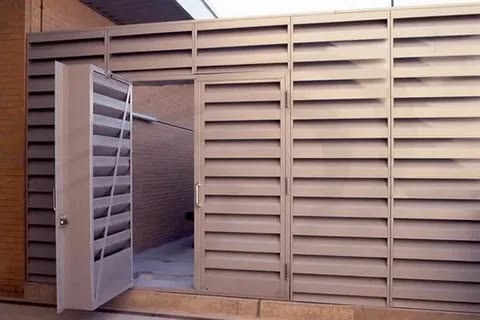
Generators are commonly installed in commercial buildings, hotels, hospitals, offices, apartment developments, factories and other facilities that require backup power. Although they provide an important service, generators can produce considerable noise during operation.
One challenge when installing a generator is balancing noise control with the ventilation required to keep the equipment operating safely. A generator enclosure that is too restrictive may interfere with cooling airflow, while a completely open arrangement may allow noise to travel easily into surrounding areas.
Aluminium acoustic louvres reduce noise transmission through ventilation openings while allowing air to pass through the system. AluminiumPro supplies and installs aluminium acoustic louvres. For general ventilation applications, see our article on Aluminium Ventilation Louvres in Kenya.
What Are Aluminium Acoustic Louvres for Generators?
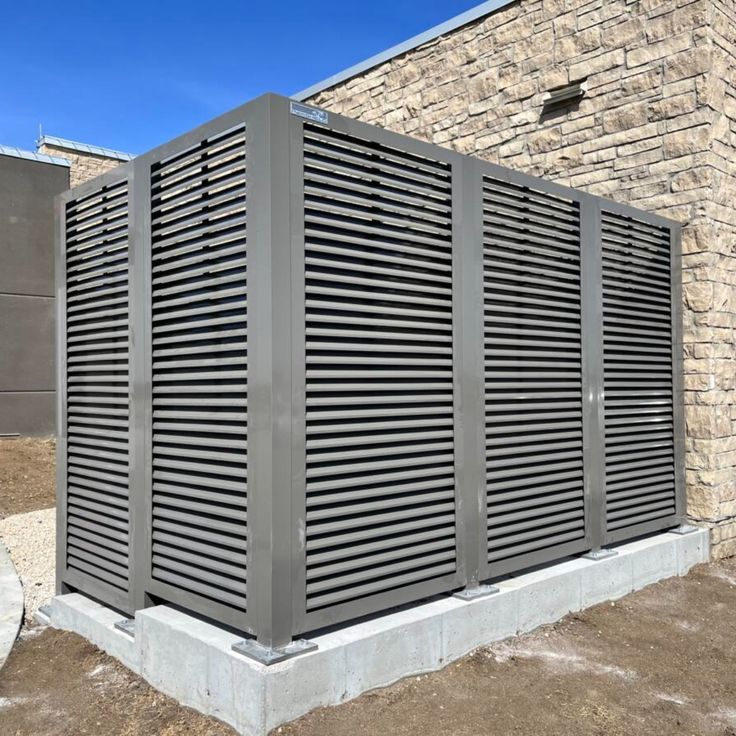
Aluminium acoustic louvres are ventilation panels that combine aluminium blades with sound-absorbing internal materials. For generator applications, the panels are installed at the air intake and discharge openings of a generator room. Their purpose is to reduce the direct passage of sound while maintaining a suitable airflow path.
A typical acoustic louvre assembly may include:
- Aluminium outer frames.
- Deep aluminium louvre blades.
- Acoustic infill material, such as suitably protected mineral wool.
- Perforated internal facings to retain the infill.
- Protective bird mesh or insect screening where required.
- Perimeter flashings and suitable fixing components.
The exact construction depends on the generator size, ventilation arrangement, acoustic target and available installation space.
How Do Acoustic Aluminium Louvres Reduce Generator Noise?
Generator noise can escape through doors, ventilation openings, gaps and other parts of the enclosure. Ventilation openings are particularly important because they must remain open enough to allow air movement.
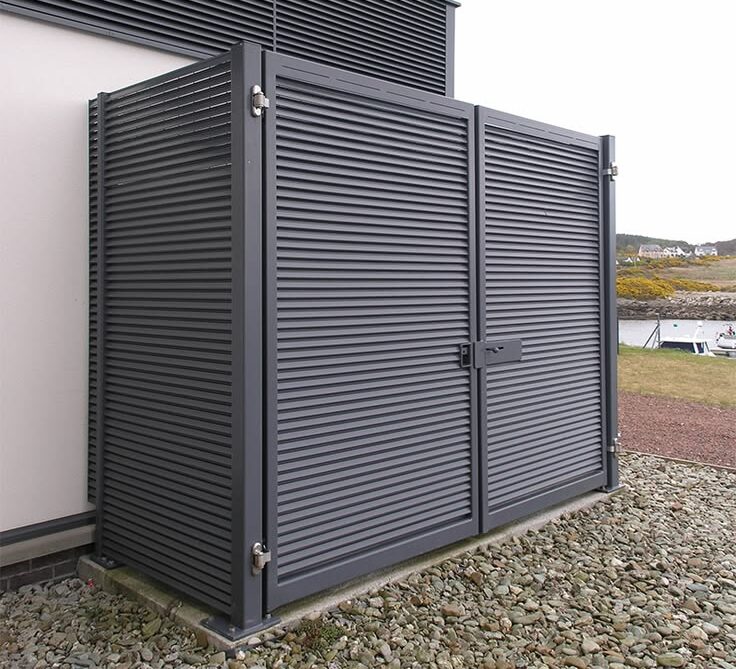
Acoustic louvres reduce direct sound transmission by creating a more complex path through the panel. The sound-absorbing infill within the blades helps absorb some of the sound energy as it travels through the louvre.
The level of noise reduction depends on the louvre depth, internal geometry, acoustic material and tested performance. It also depends on the rest of the generator enclosure.
Installing acoustic louvres alone will not necessarily solve every noise problem. Sound may still escape through poorly sealed doors, roof joints, exhaust systems, wall openings or gaps around the enclosure.
A complete noise-control solution should therefore consider all possible sound paths.
Maintaining Adequate Generator Airflow
Acoustic louvres introduce resistance to airflow because of their internal blade geometry and acoustic material. If the panels are undersized, they may restrict the air entering or leaving the generator room.
Before selecting the louvre system, establish:
Generator rating and model: Different generators have different air requirements. Use the manufacturer’s technical information rather than estimating from the external dimensions alone.
Air intake requirement: The intake opening must provide the air required by the generator and its cooling arrangement.
Hot air discharge: Heated air is discharged appropriately so that it does not circulate back into the generator room.
Free area
Pressure drop: The resistance created by the louvre must be compatible with the ventilation system.
Opening arrangement: Intake and discharge openings are positioned according to the equipment and room ventilation design.
A ventilation or mechanical engineer should confirm the required airflow and pressure-drop limits.
Aluminium Acoustic Louvre Designs for Generator Rooms
1. Fixed Acoustic Aluminium Louvres
Fixed acoustic louvres have permanently positioned blades. They are suitable for generator-room openings where a fixed ventilation arrangement is required.
2. Deep-Blade Acoustic Louvres
Deep-blade systems provide a longer internal passage and more space for acoustic infill. They may be considered where greater sound attenuation is required and sufficient installation depth is available.
3. Acoustic Louvre Banks
Large generator rooms may require multiple louvre panels arranged together to create a larger ventilation opening.
4. Acoustic Louvres with Protective Mesh
Bird guards or insect mesh may be incorporated where the installation requires additional protection. However, mesh can affect airflow and should be included in the ventilation calculations.
5. Custom Aluminium Acoustic Screens
Some generator installations require acoustic louvres combined with additional aluminium screening around the equipment. The arrangement can be developed to suit the site layout, access requirements and architectural appearance.
Generator Access Doors and Lockable Aluminium Panels
A generator enclosure must allow authorised personnel to inspect, operate and maintain the equipment. Access should not be treated as an afterthought once the louvres have been installed.
Aluminium Access Doors
Access doors provide entry to the generator for inspection and servicing. Their dimensions should accommodate the equipment, maintenance tasks and any components that may need replacement.
Where acoustic performance is important, the door construction should be compatible with the surrounding enclosure. A lightweight, poorly sealed door can become a major point of noise leakage.
Lockable Access Doors
Lockable doors help restrict unauthorised access to the generator and its controls. The locking arrangement should be suitable for the site security requirements while allowing authorised technicians to enter when maintenance is required.
Removable Access Panels
Some enclosures may require removable panels to allow access to specific equipment components. These should be secured properly during operation and reinstalled after maintenance.
Service Clearances
Access doors and panels should be positioned so that they do not obstruct routine servicing, ventilation openings or the manufacturer’s required maintenance clearances.
What Determines the Cost of Aluminium Acoustic Louvres for Generators?
The cost of a generator acoustic louvre system depends on the project specification rather than the aluminium panel dimensions alone.
- Generator size: Larger generators may require larger intake and discharge openings.
- Louvre blade depth: Deeper blades may require more material and a more substantial panel construction.
- Acoustic infill: The type, density, thickness and protection of the sound-absorbing material affect the cost.
- Aluminium thickness: The frame and blades must be suitable for the panel dimensions and installation conditions.
- Required noise reduction: A specified acoustic performance target may require a more specialised construction.
- Airflow requirement: Larger effective free areas may require larger or additional panels.
- Access doors: Acoustic doors, lockable hardware and removable panels add to the system cost.
- Supporting structure: Frames, brackets and fixings are required to support the panels.
- Surface finish: Powder coating and selected colours may affect the quotation.
- Installation conditions: Site access, height, transport and installation complexity influence labour costs.
A proper quotation should identify the louvre panel specification, access-door details, supporting frame, finish and installation scope separately.
Installation of Aluminium Acoustic Louvres for Generators
1. Site assessment: Review the generator location, enclosure dimensions, ventilation openings and access requirements.
2. Review generator information: Obtain the manufacturer’s ventilation requirements, air intake and discharge details, and maintenance clearances.
3. Establish the acoustic target: Identify the noise-control requirement and any available acoustic assessment.
4. Select the louvre specification: Confirm the blade depth, aluminium thickness, acoustic infill, free area and protective components.
5. Plan access arrangements: Locate the doors and removable panels so that technicians can reach the generator without obstructing airflow.
6. Fabricate the aluminium components: Prepare the frames, blades, panels and access components according to the approved drawings.
7. Install the panels: Secure the supporting frames and fit the acoustic louvres, doors and other components.
8. Inspect the completed installation: Check fixings, seals, door operation, lockable access, airflow paths and maintenance access.
Where the generator is installed inside a building, the exhaust system must also be designed and routed appropriately. Exhaust gases should not be discharged near air intakes, doors, windows or occupied areas.
Aluminium Acoustic Louvres vs Generator Security Screens
These two systems serve different purposes.
Acoustic louvres are designed to control sound transmission while maintaining ventilation. Security screens are intended to restrict unauthorised access and protect equipment.
A generator installation may require both, but adding security bars or mesh should not unnecessarily reduce the effective ventilation area. The protective system should also allow technicians to inspect and maintain the equipment.
For general screening and ventilation options, read Aluminium Ventilation Louvres in Kenya and Aluminium Sun Louvres in Kenya.
Related Aluminium Solutions
Generator-room louvres can be coordinated with other aluminium products and building-envelope components.
Explore our Aluminium Structures, Aluminium Doors and Curtain Walls and Facades services for related aluminium applications.
You can also read How Much Aluminium Fabrication Costs in Kenya, Powder-Coated vs Anodised Aluminium, Aluminium Sun Louvres in Kenya, Aluminium Ventilation Louvres in Kenya, Aluminium Glass Canopy Installation in Nairobi and Aluminium Pergola Prices in Kenya.
Areas We Serve
AluminiumPro Kenya provides aluminium windows and doors, glass partitions, aluminium shopfronts, roofing solutions and customised aluminium and glass installations across Nairobi, Kenya and selected locations throughout East Africa.
Within Nairobi and its surrounding areas, we serve clients in Westlands, Lavington, Karen, Kilimani, Kileleshwa, Runda, Muthaiga, Gigiri, Loresho, Lang’ata, Spring Valley, Lower Kabete, Ruaka, Utawala and Ruiru.
We also undertake projects in major towns and cities across Kenya, including Mombasa, Kisumu, Nakuru, Eldoret, Naivasha, Meru, Thika, Machakos and other surrounding areas.
Whether you require aluminium acoustic louvres, ventilation panels, aluminium doors, façade improvements or customised aluminium installations, AluminiumPro Kenya is ready to discuss your project requirements.
Beyond these locations, we welcome enquiries for suitable projects throughout Kenya and East Africa. Contact our team to confirm service availability, arrange a project assessment and request a quotation.
Request a Quote for Aluminium Acoustic Louvres
Are you planning an acoustic louvre installation for a generator room, commercial building, hotel, hospital or industrial facility?
Contact AluminiumPro Kenya with the generator details, opening dimensions, ventilation requirements, acoustic target and access-door requirements. Where available, share the generator manufacturer’s technical information or project drawings to support the quotation process.
Call or WhatsApp:
- 0717 044 443
- 0739 255 050
- 0725 021 709
AluminiumPro Kenya – Custom Aluminium Solutions for Residential and Commercial Buildings.